AI Content and SEO in 2026: Does Google Penalize It and How to Write Texts That Rank
People ask me regularly: "Oleg, if I write a text with ChatGPT or Claude, will Google ban me?" The short answer is no. Since AI entered our lives, I haven't seen a single "ban for AI" as such. But that doesn't mean you can generate texts in bulk and wait for traffic.
Something else happened, and it matters more. AI has drastically lowered the bar: anyone can now write a "decent" text in a minute. So Google raised its own bar. What was acceptable two years ago today simply doesn't get indexed or sits on page three. Danny Sullivan said as much at Google Search Central Live in Toronto in April 2026: since AI has made content production cheap, the search engine has had to raise the requirements for what gets into the index at all.
In this article: whether Google can detect AI, what it actually demotes sites for, and how I use AI in client projects myself — so that it works for rankings, not against them.
Can Google Detect AI Content?
It would be naive to think it can't. This is the company that rolled out AI Overviews and AI Mode in search itself. Recognising the typical patterns of AI-generated text is no problem for Google or for third-party tools.
But here's what matters: detecting AI isn't Google's main goal. The search engine basically doesn't care whether a human or a machine wrote the text — it cares about something else: is the page useful or empty? Google has been saying this openly for several years: the fight isn't against AI but against low-quality content, whoever created it.
Then there are behavioural signals. If someone lands on a page, skims it for a couple of seconds and goes back to the search results, that speaks for itself: little time on the page, a quick return, low satisfaction. Who wrote the text — a machine or a living author — doesn't matter for that signal.
What Google Actually Punishes (and Why It's Rarely a "Penalty")
First, about the word "penalty" itself. In most clients' heads it works like this: you wrote something bad → a ban arrives → the site disappears. In practice it almost never happens that way.
Manual actions are the extreme case: mass spam, thousands of templated pages, crude manipulation. If you run a normal business website, you will most likely never face this.
Much more often the "punishment" is quiet: the page simply doesn't grow. It isn't indexed. It loses positions in the next update. No notification, no drama — just zero traffic.
A good example is the March 2026 update. Analysts broke down who lost ground: the hardest hit were "intermediary" sites — aggregators, directories, comparison services. The ones that can be replaced by any other site just like them. Meanwhile clear primary sources grew: official websites, niche specialists, well-known brands. If your page retells what's already in the top results, you're a redundant link in the chain.
This is where the real danger of AI content lies. Not in the fact that it's "artificial", but in the fact that on autopilot it produces exactly this kind of mass-market filler: averaged, without a point of view, something anyone could have written. Sullivan said it too: generic, widely available content has less and less chance in Google.
Can an AI Text Reach the Top?
Yes. And the numbers confirm it.
An Ahrefs study analysed hundreds of thousands of pages. The conclusion: most top-ranking pages today are written with AI involvement. Purely human text with no AI at all accounts for only about 13.5% of top results. At the same time, pages generated entirely by a machine rarely take first place. There's no direct "AI helps" or "AI hurts" correlation with rankings.
In short: Google looks at usefulness, not authorship. AI-assisted text ranks when it has been edited, fact-checked and tailored to a specific query. And it fails when it's published as is, unedited, by the ton.
One more figure — for those who rushed to bury SEO. According to the State of Search report for Q1 2026 (Datos and SparkToro), Google holds 93% of the market in the US and 95.5% in the EU and the UK. All AI search (ChatGPT and the rest) accounts for less than 2% of traffic. In other words, SEO hasn't gone anywhere. What's more, the easiest way to get cited by ChatGPT is to rank well in Google first.
How I Use AI in Real Projects
Now for specifics — advice without practice is exactly the interchangeable content I wrote about above.
I have a team of AI specialists set up for different tasks: SEO, copywriting, development, advertising. But not a single text goes to a client in the form the model produced it. For me, AI is a draft and an accelerator, not the author.
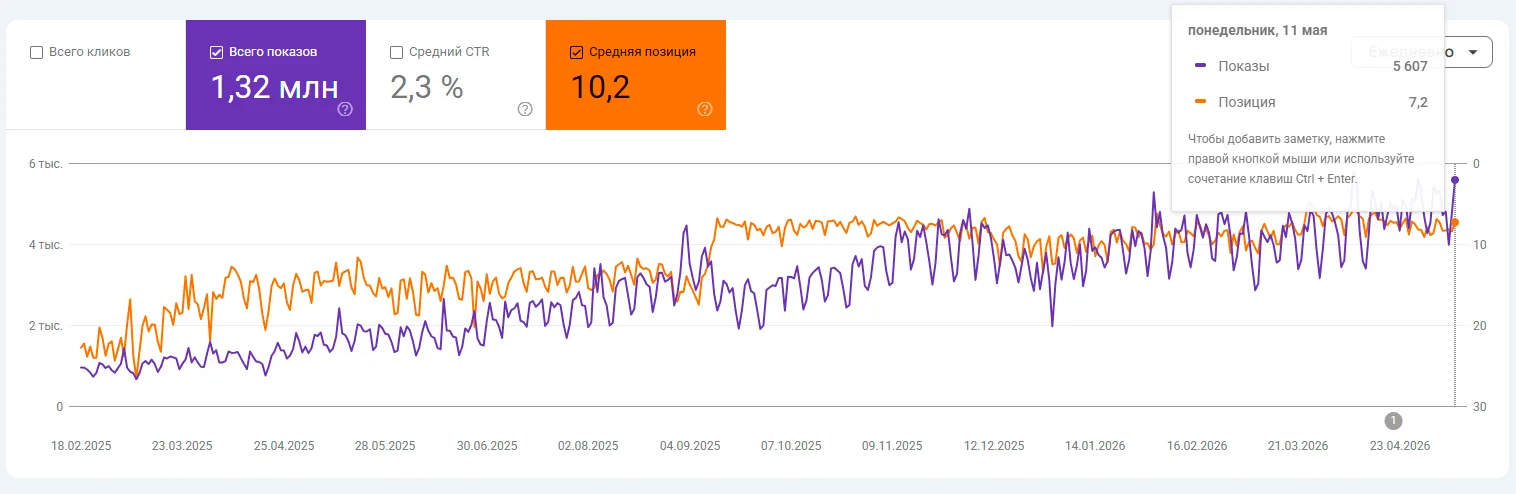
Diplomat-Med (medical clinic). Medicine is YMYL — "your money or your life". Google is as strict as it gets here, and rightly so: a mistake in a medical text is paid for with a real person's health. AI helps with structure, with a draft, with explaining complex things to patients in simple language. But every statement — diagnoses, contraindications, procedure descriptions — gets checked. Anything the model "made up" or took from an outdated source is cut. Without real medical oversight such a text can't be published — not for the sake of SEO, but out of responsibility. The result is visible in Search Console. At the end of 2024 the site was getting up to fifty impressions a day — the homepage ranked decently in Google, but that was it, with almost no real benefit. After the relaunch and content update, more and more pages started ranking for real queries: since then the site has gained more than 1.5 million impressions with an average position of 9.9 — the first page. And it kept growing even after the September 2025 algorithm change that hit many sites hard.
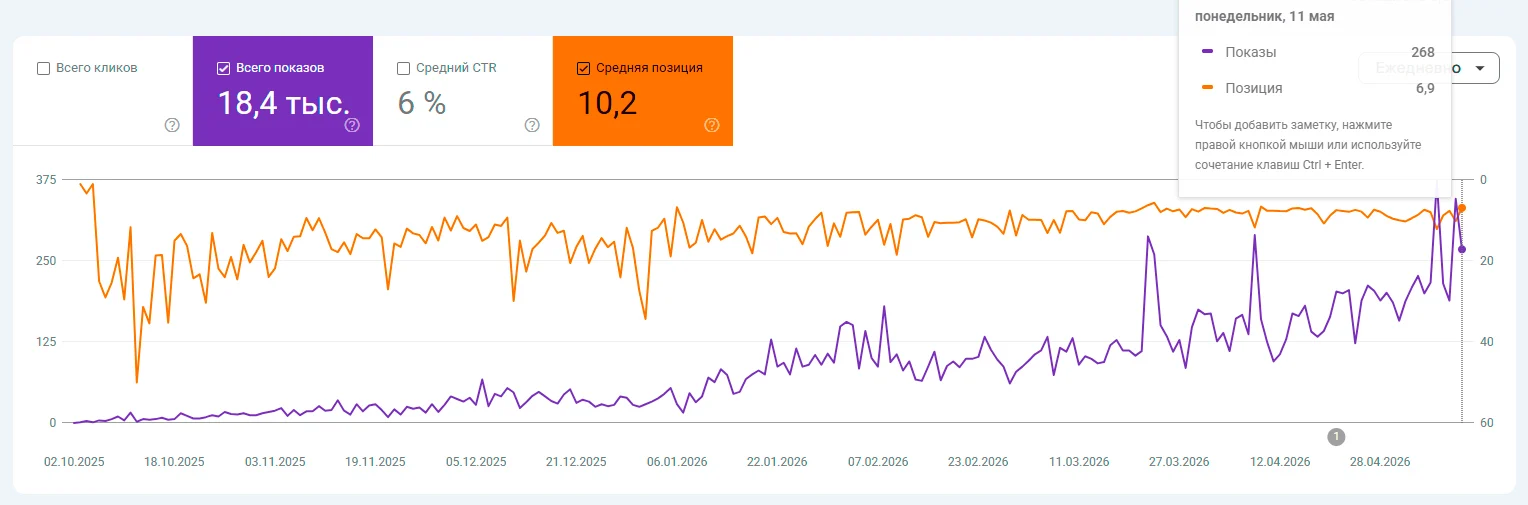
Baie.Omtek (Radaway shower enclosures, e-commerce). Here the pain is different — hundreds of product pages. The temptation to generate descriptions in bulk is huge, and that's exactly what competitors do: the result is interchangeable pages. I use AI for the basic structure, but add what the model doesn't have: real dimensions, the realities of the market, installation nuances, model comparisons, answers to the questions buyers ask in person. A product page should settle the choice, not retell the specification from the manufacturer's website. Work on the product pages is still in progress, but the blog results are already visible: the guide "How to choose a shower enclosure" reached #1 in Google and was featured in an AI Overview — Google doesn't just rank the page, it cites it in its AI answer. Exactly what I wrote about above: if you want AI to cite you, first reach the regular top results. The site itself reached an average position of 9.4 with a CTR of 5.9% from launch.
Panos Melekkis (jewellery, Cyprus/UAE). A premium segment and two cultures at once. AI is strong at drafts in several languages, but tone, emotion and brand voice are all done by hand. Luxury copy written on autopilot instantly reads as cheap. And for a jewellery brand, cheap copy means a lost customer.
The common principle in all three cases: AI does 60–70% of the groundwork, and the remaining 30–40% — my experience, facts and editing — is exactly what makes Google lift a page in the results.
Checklist: How to Create AI Content That Ranks
I've summed up my approach in six points.
1. AI speeds things up but doesn't think for you. Use it for brainstorming, structure, drafts and polishing wording. But add the things that actually push a page to the top yourself: your experience, specific examples, screenshots, a clear conclusion.
2. Fill real gaps instead of retelling the top results. If your text says exactly the same as the first ten results, the search results don't need you. Look for questions competitors avoid: long-tail niche queries, topics that require experience rather than a summary.
3. Every model output is a draft. Read it with an editor's eye: does it sound like you? Is it true? Does it answer the person's question or circle around it? Places where the text is "watered down" and overly cautious are usually the first candidates for rewriting.
4. Fact-check ruthlessly. A simple rule: if a reader could make a decision based on it, double-check it. Prices, timelines, specifications, medical and legal claims. AI is fast, but it bears no responsibility. One error caught by a reader, and everything else on the page is in doubt.
5. Think about the person, not the keyword. Behind every query is a real person with a task. Can they skim the page and still get value? Is there a clear next step? If after reading the person is confused and opens five more tabs, the text isn't finished.
6. Learn to prompt. Spend a minute on a proper prompt and you'll save an hour on edits. Spell out clearly: who the text is for, which question it answers, how detailed it should be, what to leave out. AI works well when it's directed, not when it's guessing.
E-E-A-T in Plain Words
Behind the acronym E-E-A-T (experience, expertise, authoritativeness, trustworthiness) is one simple idea: Google wants to see that the content is backed by a person who really knows the subject.
AI can't provide experience. It hasn't treated patients, installed a shower enclosure or sold a five-thousand-euro ring. All of that comes from a human. That's why pages that show real work — case studies, lessons from practice, concrete results — hold their positions far better than templated ones.
In practice this means: name the author, create author pages, link to primary sources, and add what AI physically can't generate — your working methods, case studies, your opinion.
FAQ: AI Content and SEO
1. Does AI content affect SEO?
It does, both ways — it depends on execution. If you flood your site with generated texts without editing or checking, you're playing blind. Editing, fact-checking and your own perspective keep AI-assisted texts competitive.
2. Does Google recognise texts rewritten by AI?
Often, yes. A text that AI simply "paraphrased" keeps the structure and ideas of the source, just in different words — and Google sees that you added nothing new. A rewrite has no value in itself. The value lies in what you add on top: experience, examples, your own angle.
3. Does AI work for product pages?
Yes, but not on autopilot. Across dozens or hundreds of product pages, AI is indispensable for structure and a first draft. The problem starts when descriptions are generated in bulk — you end up with pages indistinguishable from your competitors'. Add what the model doesn't have: real dimensions, installation nuances, comparisons, the questions buyers actually ask.
4. What if a competitor publishes dozens of articles a day?
Don't try to beat them on quantity — you'll lose. At large volumes Google filters out the surplus of average content anyway. Ten pages that genuinely answer questions are better than a hundred templated ones. In a niche, experience beats speed.
5. Is there an ideal AI-to-human ratio?
There's no magic percentage. In practice the combination that works best is: AI for the draft and structure, a human for judgement, examples and polish. If a page inspires trust and delivers value, the ratio itself doesn't matter.
6. Should you use AI more in 2026?
As an accelerator — yes. As a replacement for your brain — no. Especially in YMYL niches (health, finance), where publishing without human oversight is dangerous.
Conclusion
In 2026 the rule is simple: Google ranks by quality and usefulness, not by who was at the keyboard — a human or a model. AI is a great tool for moving faster. But mass-producing mediocrity with it has become risky — the bar has been raised, and averaged content keeps losing positions.
The best content today is AI plus a human: the draft from the machine, the substance from you.
SEO in the age of AI isn't about more text — it's about text that brings in customers. If you want your website to do that rather than just "exist", let's talk. I work with healthcare, e-commerce, service businesses and premium brands. Write to mail@visan.pro and I'll tell you right away what's worth changing in your content.
Sources
- State of Search Q1 2026 — Datos & SparkToro
- Ahrefs — AI-generated content does not hurt your Google rankings
- Aleyda Solis — analysis of the Google March 2026 Core Update
- Notes from Google Search Central Live Toronto, April 2026 (J.C. Chouinard)
- Google — Creating helpful, reliable, people-first content