Part 2: SEO Mistakes. Why SEO Is Not Working: Mistakes in Content and Links
In the first part we covered the fundamental elements of an SEO strategy: setting goals, working with keywords, on-page and technical optimization, and analytics.
That is the base level: the architecture on which growth is built.
In practice, however, a paradoxical situation often arises: the strategy is in place, the structure is built, technical errors are fixed, keywords are distributed correctly, and yet the dynamics remain weak or unstable.
The site isn't falling. But it isn't growing either.
I run into this regularly in my work: formally everything has been done right, but the site seems to hit a ceiling.
In most cases the cause lies deeper: in the content model and the link strategy.
What a content model is in SEO
A content model is not just publishing articles or filling in service pages.
It is a systematic approach to building topical authority.
It answers these questions:
- which topics the site covers and in how much depth,
- how the materials are connected to each other,
- which clusters build expertise,
- how priority is split between informational and commercial pages,
- how content supports the strategic growth points.
The content model determines how strongly a search engine perceives the site as a source of expertise in its niche.
Without a well-thought-out model, even a technically sound site remains a collection of separate pages rather than a coherent expert system.
I often see sites where content is produced regularly but without an overall model, and over time that is exactly what limits growth.
What a link strategy is
A link strategy is not the process of "buying links."
It is the management of external trust signals.
It answers these questions:
- which pages need to be strengthened,
- which types of resources it makes sense to get mentions from,
- what the pace of growth should be,
- how the anchor text is distributed,
- how a natural profile is built.
If content builds internal authority, links build external authority.
It is the balance of these two elements that allows a site to move beyond basic visibility.
In this article we'll look at the mistakes most often made at exactly this level: in the content model and the link strategy.
They are frequently the reason why website SEO delivers limited or unstable results, even when the strategy is formally correct.
1. Content strategy mistakes
Content is not filler for a website. It is a mechanism for building trust and topical authority.
If in the first part we talked about strategy as the direction of travel, here we're talking about what actually makes that direction work. It is content that explains to a search engine why the site deserves to grow.
And this is exactly where problems often appear that don't look critical but systematically slow down growth.
1.1. Content written for algorithms, not for users
One of the most common mistakes is replacing the user's logic with keyword logic.
The article is built around a phrase rather than a problem. Paragraphs are adjusted to hit a keyword density. Headings are written to include the query rather than to structure the thought.
As a result, the text becomes technically "optimized" but unconvincing.
Algorithms have long analyzed not only keywords but also user behavior: does the user go back to the search results, do they read the material to the end, do they interact with the page.
If the material doesn't answer the question in depth and systematically, no keyword density will make up for that gap.
In practice this means that work should start not with search volume but with an analysis of the search results. On any project, I first analyze the top results and only then open the keyword file.
Before writing, it helps to look at:
- which formats dominate the top results,
- which sub-queries competitors cover,
- which blocks repeat across several sites.
Only after that does it make sense to structure the material and then carefully integrate the key phrases.
1.2. Shallow content
Scaling through quantity is a common illusion.
Posts come out regularly, but each one touches the topic only at the level of a basic description. No examples. No analysis. No expansion into subtopics.
A search engine compares pages not by the fact that they exist but by the depth of coverage. If a competitor offers a structured solution with details and additional sections, it builds greater topical weight.
This is especially noticeable in competitive niches, including international SEO, where the audience is already familiar with the basics and expects a well-argued presentation.
It is far more effective to create cornerstone content, articles that cover a topic completely, and then strengthen them with internal linking and updates. This approach builds a stable structure rather than a scattered archive of posts.
1.3. Not updating materials
Content ages even when it seems up to date.
The structure of the search results changes, new answer formats appear, competitors expand their materials. As a result, the page gradually loses positions without any obvious mistake.
Regularly reviewing content lets you not only hold positions but also strengthen them. Often it is enough to:
- expand a section,
- add current data,
- refresh the wording,
- strengthen internal links.
In practice, updating existing materials often delivers a faster effect than publishing new pages, because the page already has a history and accumulated signals.
Mini case: reworking outdated medical content
On one medical project, we worked with a site that had existed for more than 7 years. It had about 80 articles, each available in three languages. Traffic was stable and generally good, but growth had practically stopped.
The analysis made it clear that most of the materials had been created to old requirements:
- a fixed text length "by character count,"
- a generic structure without a clear hierarchy of topics and subtopics,
- no expert reinforcement,
- weak linking between related materials.
In addition, some articles fell into the YMYL (Your Money or Your Life) category, which meant the requirements for quality and expertise were significantly higher. In recent years, algorithms have become much stricter in evaluating medical content, paying attention to structure, depth and the authority of the source.
We decided not to create new materials but to completely rework the existing ones:
- rewrote the articles according to current requirements for structure and topic coverage,
- split large blocks into logical subtopics,
- added a heading hierarchy,
- strengthened internal linking,
- reworked the wording to remove the template feel,
- added elements of expert presentation.
After the update there was a short-term dip in traffic, as search engines needed time to reindex. This is a normal effect of a deep content overhaul.
However, after a few weeks the numbers began to recover and then exceeded the previous level. The growth was especially noticeable for mid-volume and long-tail queries, the ones the pages had previously only partially "caught" but not fully answered.
This case illustrates an important point well: mass content production does not guarantee long-term growth. Sometimes revisiting existing materials in line with new quality standards has a stronger effect than publishing new pages.
1.4. AI content without editorial work
Using AI tools has become the norm. They speed up the preparation of structure and drafts.
The problem arises when content is published without expert revision.
Template phrasing, generic conclusions, a lack of specifics: all of this makes the text look like dozens of similar materials.
Search engines analyze pattern repetition and overall usefulness. If a page contains no unique perspective or practical experience, it does not strengthen the site's authority.
AI can be used as an auxiliary tool: for gathering ideas, building structure and expanding the range of topics. But the final material must include expert editing, market-specific nuances and real observations.
1.5. Ignoring expertise (E-E-A-T)
Content doesn't exist in isolation from its source.
A search engine evaluates not only the text but also who publishes it. Is there an author? Is there proof of competence? Is the business transparent?
In commercial areas, especially when it comes to SEO services, demonstrating expertise becomes a critical factor. It isn't enough to claim experience; it has to be shown in a structured way:
- through case studies,
- through analytical conclusions,
- through a transparent approach,
- through logically built arguments.
Expertise is not an "About us" section. It is a way of presenting material.
However, even high-quality expert content does not guarantee growth if there is no systematic work with external signals.
2. Link strategy mistakes
If content builds a site's internal authority, links build its external authority.
Search engines see the link profile as an indicator of trust: who mentions the resource, and in what context.
However, the problem more often comes not from a lack of links but from the wrong model of working with them.
2.1. Links as mechanical buying rather than a strategic tool
Buying links in itself does not break the logic of promotion.
Careful selection of sites, topical relevance, natural integration: all of this can work.
The mistake begins when link work comes down to regularly "adding links" without understanding the overall picture.
If you haven't defined:
- priority pages,
- clusters that need strengthening,
- an acceptable pace of growth,
- anchor text distribution,
the profile develops chaotically.
As a result:
- some pages get excessive reinforcement,
- others are left without support,
- the profile looks unnatural.
A link strategy should be a continuation of the overall SEO model, not a parallel process.
I don't consider buying links "forbidden" in itself. The question is always whether there is a system.
2.2. Ignoring donor quality and placement context
Not every site is equally useful.
It's important to consider:
- topical relevance,
- the domain's level of trust,
- how natural the link's surroundings are,
- the number of outbound links on the page,
- the resource's real traffic.
A link placed in an article that exists solely to sell links rarely strengthens authority.
Context matters far more: a mention in an expert article, an analytical review or an in-depth topical piece sends a much stronger signal.
That's why donor analysis should be meaningful, not formal (by DR/DA).
2.3. Over-optimized anchor text and artificial growth patterns
When most links contain an exact-match commercial query, the profile looks manipulative.
A natural link profile is always diverse:
- brand mentions,
- URL anchors,
- partial-match phrasing,
- neutral phrases.
The growth pattern matters too. A sharp spike in links without a logical news hook can be perceived as artificial reinforcement.
The link profile should develop in step with the site's content and visibility.
2.4. Unrealistic expectations of natural links
There is a widespread belief that it's enough to write a good piece and the links will come by themselves.
In practice, this works far less often than people think.
According to Ahrefs research, more than 90% of pages on the internet don't get a single external link. This means organic link building has never been an automatic process. Even high-quality content does not guarantee natural mentions.
In addition, the volume of published content has grown many times over in recent years. AI tools have made writing texts easier, which has intensified the competition for attention. The amount of content is growing faster than the number of sites willing to link to it.
This changes the context of link work.
If you used to be able to count on links accumulating naturally as you published useful articles, today even a strong piece needs promotion: outreach, communication, mentions in the professional community.
Quality, however, is still the foundation. Content that:
- contains unique analysis,
- presents research,
- shares a practical case study,
- offers a structured, in-depth breakdown,
has a much higher chance of earning external mentions than a typical overview.
So a link strategy has to take two realities into account:
- Natural links are the exception, not the rule.
- Competition for attention is intensifying.
This means creating "linkable assets," materials that objectively stand out in depth and structure, is still the goal. It's just no longer rational to rely solely on organic distribution without additional outreach.
3. Local and multilingual SEO mistakes
Local SEO is not just adding the name of a country to the title tag.
For a business focused on specific markets, regional optimization becomes part of the overall strategy. This is especially relevant for projects working in multilingual markets, where:
- each individual market can be relatively small,
- several languages coexist,
- part of the demand is expressed in English and part in the local language,
- users often switch between languages.
Ignoring these factors limits growth potential even with a strong overall strategy.
3.1. Misunderstanding the language structure of the market
In many markets, search demand is split between several languages. This means that:
- the same services are searched for in different languages,
- queries differ not only in translation but also in structure,
- some niches show a mixed format (for example, a brand name in one language plus a description in another).
The mistake happens when a site:
- targets only one language,
- duplicates content without adaptation,
- doesn't analyze the real structure of demand.
Multilingual SEO requires treating each language as a separate cluster, not simply localizing the text.
It's important to remember that direct translation is not optimization. Keyword research has to be done separately for each version.
3.2. Uneven development of language versions
In multilingual markets, one of the most common problems is a different level of quality between the language versions of a site.
Historically, building a full multilingual structure was an expensive and labor-intensive process. Development, translation, editing, maintenance: all of it required separate resources.
In reality, many companies had a "language bias."
I see such imbalances quite often, especially on sites that were actively developed 5–7 years ago.
The development or marketing team worked mainly in one language. The second version of the site was built on a leftover basis.
Keeping an in-house translator to regularly update a large volume of materials made no economic sense. As a result:
- one language version was actively filled and updated,
- the second remained partially translated,
- some pages had no counterpart at all,
- new articles were not systematically duplicated.
This had a direct impact on visibility.
You could see situations where one language version of a site ranked at the top for commercial queries, while the other version didn't even make the first few pages of results for the equivalent phrasing.
A search engine treats each language version as a separate relevance segment. If the content is incomplete or structurally weaker, it will not compensate for that with a strong version in another language.
How AI has changed the approach
The situation began to change with the development of AI tools.
Producing good draft translations and adaptations has become much easier and cheaper. It is now technically possible to develop all language versions evenly without multiplying the budget.
However, this doesn't remove two important conditions:
- A translation should be an adaptation, not a literal copy.
- In topics with specialized terminology (medicine, law, finance), human review is essential.
AI lowers the barrier to entry, but it doesn't replace editing.
Strategic takeaway
Today, a weak language version is more often a result of the lack of a system than of a lack of resources.
If a business relies on SEO in markets where search demand is split between languages, it makes sense to develop the versions in parallel:
- the same structure,
- a comparable volume of content,
- synchronized updates,
- correct hreflang setup,
- separate keyword research for each language.
Otherwise, one version will generate most of the traffic while the other remains an underused asset.
3.3. Missing hreflang and local signals
If a site has several language versions but doesn't use hreflang, a search engine may:
- show users the wrong language version,
- mix up indexing,
- create internal competition between versions.
Hreflang helps clearly indicate:
- which region and language a page is intended for,
- which version is the alternate.
Local SEO also includes other signals:
- a properly set up Google Business Profile,
- consistent contact details everywhere,
- local mentions,
- listings in relevant business directories and regional media.
In smaller markets, where the professional community is relatively compact, such signals build trust faster than in larger ones.
But even with a correct local structure and a well-thought-out promotion model, results can be held back by the wrong expectations on the business side.
4. Myths and distorted expectations about SEO
SEO mistakes often start not with algorithms or technical problems.
They start with a lack of understanding.
Many entrepreneurs decide to "do SEO" without fully understanding what the process is, what problems it solves and what resources it requires. This creates expectations that later turn into disappointment.
4.1. "SEO is just getting to the top"
For many business owners, SEO comes down to one phrase:
"We need to get the site to the top."
But SEO is not a position for a single query. It is:
- working with the structure of demand,
- building authority,
- managing behavioral signals,
- building a content model,
- controlling the technical architecture,
- developing the link profile,
- adapting to algorithm changes.
That's why the expectation of "getting to the top" often oversimplifies reality. When an entrepreneur sees SEO as a "service for getting to the top," they don't see the whole system.
That's why questions arise:
"Why does it take so long?"
"Why is it so expensive?"
"Why are there no instant results?"
In reality, SEO is the management of a complex ecosystem.
4.2. "If I have a website, SEO should work automatically"
Many companies bet on their website as their main sales channel. They invest in design, development and content. Yet they treat SEO as something secondary.
It's important to understand: a website without SEO is just a digital shop window.
If a business is counting on organic traffic, SEO becomes not an option but a mandatory part of the strategy. Search results are a competitive environment. If you're not working on visibility systematically, someone else is.
And there's one more thing to realize: SEO is not a one-time setup. It is a process that accompanies a website throughout its development.
4.3. "SEO is expensive" and "SEO should be cheap"
An interesting paradox.
On the one hand, SEO is perceived as an expensive service. On the other, the market always has offers of "promotion on a minimal budget."
Why does this gap exist? Because the complexity of SEO keeps growing.
Algorithms are becoming smarter. New areas have emerged:
- AEO (Answer Engine Optimization): optimizing for answers and rich result formats,
- GEO (Generative Engine Optimization): adapting to AI search and generative answers,
- the growing role of behavioral factors,
- higher E-E-A-T requirements.
Yes, the development of AI has simplified some processes: content is created faster, data is analyzed faster.
But at the same time, the demands on the specialist have grown.
Today an SEO specialist needs to understand:
- a site's technical architecture,
- analytics,
- the structure of demand,
- how AI search works,
- the logic of rich snippets,
- the impact of user experience.
That's why today I see SEO not as a service but as strategic support for a project. It's no longer "setting up meta tags." It's strategic work.
So the price is determined not by the number of keywords but by the level of expertise.
4.4. "The main thing is to increase traffic"
Traffic growth is the easiest metric to understand. It's easy to measure, show in a report and compare with the previous period.
But SEO stopped being a race for clicks a long time ago. Modern algorithms increasingly focus not just on keywords but on entities, that is, topical objects and the relationships between them.
Google analyzes:
- which topics the site covers,
- how deeply they are covered,
- whether the pages are logically connected,
- whether the resource forms a complete picture within its niche.
This is the basis of entity-based SEO.
If a site publishes isolated materials with no logical connection, it looks like a collection of pages. Such sites can indeed get traffic, but they rarely achieve lasting dominance in their niche.
If, on the other hand, it builds a cluster structure, with core topics and supporting subtopics linked in a well-thought-out way, it begins to be perceived as an expert entity in its field.
And here informational content plays a strategic role. Yes, informational queries don't always lead to an instant conversion. But they:
- broaden topical coverage,
- strengthen internal connections,
- build authority on related entities,
- attract natural mentions,
- increase branded searches.
As a result, the search engine starts to see the site as more competent across the entire topic, not just for individual commercial phrases.
With a properly built cluster model, informational materials can indirectly strengthen commercial pages through internal linking, accumulated trust signals and broader topical coverage.
So the question is not whether you need informational traffic. The question is whether it is built into the strategy and connected to commercial growth points.
4.5. "SEO can be replaced by advertising"
Search advertising delivers fast results. That creates a sense of control: turn on a campaign, get traffic.
But advertising is renting attention. SEO is building a long-term asset.
When the ad budget is cut, the flow of visitors practically stops. Organic traffic keeps working even when investment goes down.
At the same time, research shows that organic search remains the largest source of traffic and revenue for most websites. In some industries, more than 40–50% of revenue comes from the organic channel.
In addition, users who arrive from organic results often show a higher level of trust in the site. They perceive the result as "chosen by the algorithm" rather than bought through advertising. In a number of e-commerce studies, the conversion rate of organic traffic turns out to be comparable to or higher than that of paid traffic.
This doesn't mean advertising isn't needed. Advertising is a tool for acceleration. SEO is a tool for accumulation.
In practice, the most resilient strategies combine both channels:
- advertising helps test demand and get fast data,
- SEO consolidates positions and reduces dependence on paid traffic.
Giving up SEO in favor of advertising alone means strategic dependence on constant spending.
Conclusion
In this second part, we looked at mistakes that lie deeper than technical optimization.
In my work I increasingly see that these levels, content and links, are exactly where projects either start to scale or get stuck.
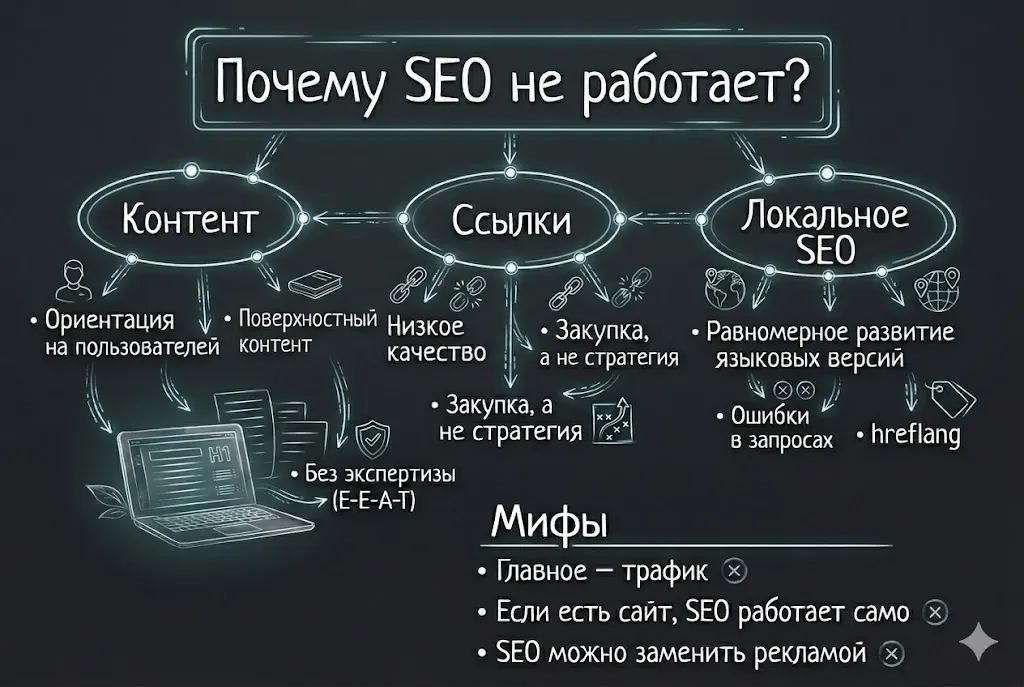
The content model, the link strategy, local and language adaptation, and a realistic understanding of what to expect from SEO: these are the elements that most often determine whether a site will grow steadily or stay stuck in stagnation.
You can fix technical flaws. You can do the keyword research. You can speed up loading. But if:
- the content doesn't build topical authority,
- language versions develop unevenly,
- the link profile is built without logic,
- the strategy is based on myths,
growth will be either unstable or short-lived. And it's not a matter of luck. It's a matter of having a system.
SEO today is not a set of tricks but a managed system for developing a digital asset.
This is especially true for companies competing in fast-moving markets, where competitors react quickly to change. There, a systematic approach gives you an advantage, while chaotic actions quickly show up in the numbers.
Putting both parts together, it becomes clear: SEO is not a set of scattered actions but a single development model.
The first part was devoted to the foundation: strategy, structure and the technical base. The second, to content and external signals.
Only together do these elements produce a lasting result.
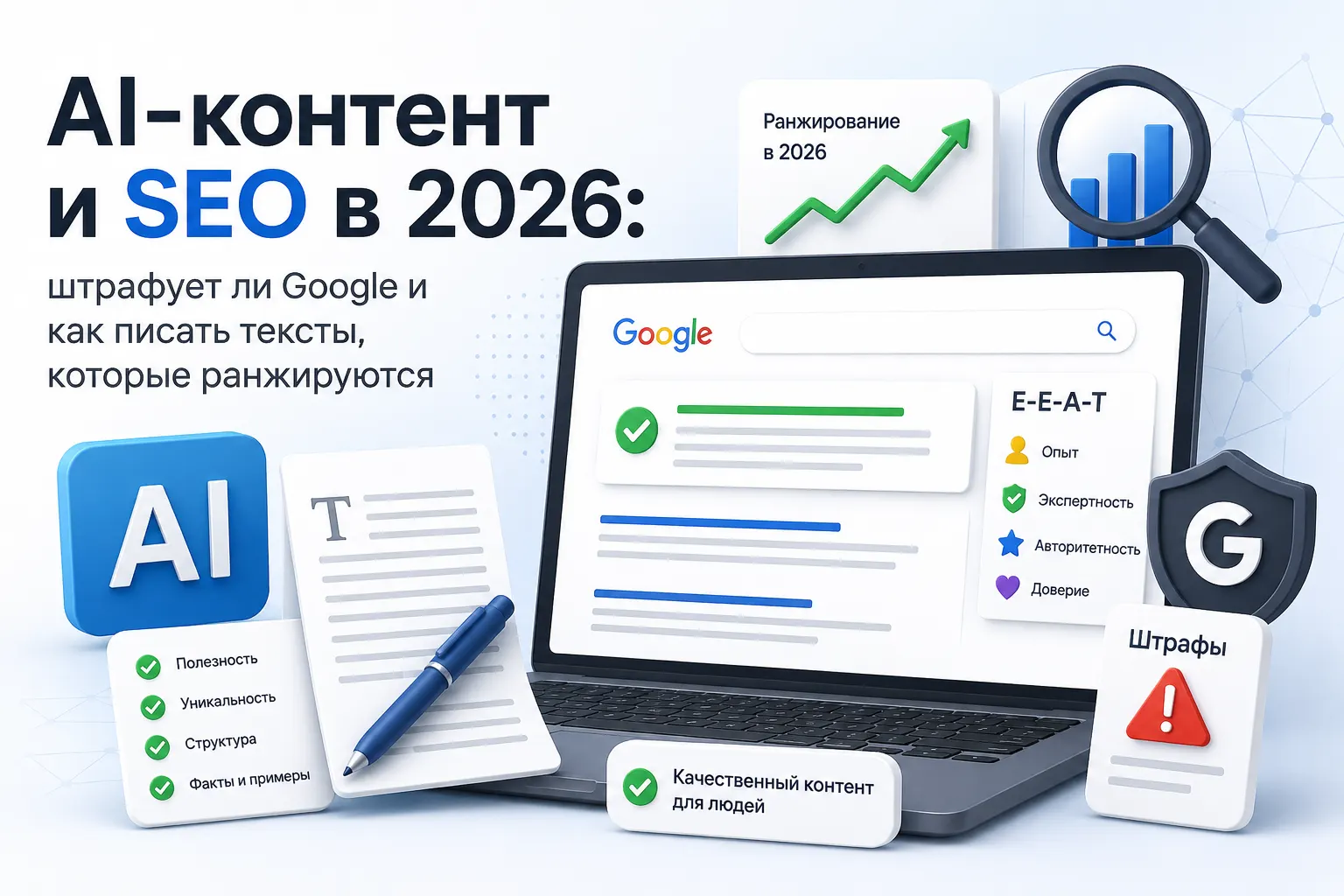
Related: AI content and SEO in 2026: does Google penalize it?