SEO or Google Ads: What Should a Small Business Choose?

If you own a small business and are wondering where to put your first money into promoting your website online, this article is for you. "Which is better, SEO or ads?" is a question almost everyone asks when they're just starting to figure out online marketing. And it makes sense: the budget is limited, and you want to know what will work faster and more reliably.
I've been promoting websites for more than 17 years. In that time I've worked with online stores, clinics, service companies and manufacturers in many different countries. And I can tell you there is no clear-cut answer to "SEO vs PPC". What there is, though, is experience, observations and an understanding of how the market has changed over the years.
In this article I'll explain how I arrived at my position, what has changed in search and advertising, when one works and when the other does, and how to make this decision today — based on reality, not marketing promises.
How it used to work
When I was just starting out, everything was simpler. You launch Google Ads — the phone rings. You do SEO — the site reaches the top and steadily brings in leads. Cause and effect were obvious: you invest, you get results.
Back then the rule of three touches worked. A person saw your offer three times and was ready to buy. Competition was lower, there were fewer ad blocks in search results, and trust in advertising was higher. Clear rules, predictable results.
But it couldn't last forever.
What has changed in recent years
The changes came gradually, and at first they were easy to miss. Conversion dipped a little here, a click got more expensive there, a customer took longer to decide before buying. It seemed normal — the market, seasonality, competitors getting more active. But over time it became clear: these weren't temporary fluctuations, this was a new reality.
The first thing that changed was people themselves. They learned not to see ads. It's called banner blindness, but it's actually broader than that. We're all so used to being constantly lured somewhere that the brain automatically filters out advertising messages. Blocks labeled "Sponsored" in search results — skipped. Banners on websites — skipped. Pop-ups — closed without reading. It's not malice, it's a defensive reaction to information noise.
The rule of three touches stopped working. Today marketers talk about seven, ten or even fifteen touches before a person makes a decision. They'll see your ad, then google reviews, then look at competitors, then forget, then stumble upon you again, then ask friends, then visit the site once more — and only then, maybe, submit a request. The customer journey has become longer and more tangled.
But the most serious changes happened in search itself. Google started building AI answers right into the results. Now, when a person types a query, a block with an AI-generated answer often appears at the top. It's called AI Overviews, and specialists have already come up with new acronyms — AEO (Answer Engine Optimization) and GEO (Generative Engine Optimization).
What does this mean in practice? Even if you rank first organically or paid for the top ad spot, you might simply go unnoticed. Because above you sits a huge block with an AI answer. The user gets the information without clicking anywhere. They don't even scroll down to your site.
Search results in general have become overloaded. First come the ads, then the AI answer, then the "People also ask" block, then maps, then videos, and only somewhere below — the organic results. Breaking through this noise has become much harder.
So here's the situation: ads work worse because people ignore them. SEO is harder because the results page is crammed with other elements. And people make decisions more slowly and cautiously. That's not a reason to give up — it's a reason to rethink the approach.
SEO today — what it gives and what it requires
Despite all the changes, SEO hasn't gone anywhere. What's more, for many businesses it's still the foundation everything else is built on.
What SEO gives you
First and foremost — free traffic. Yes, you invest in work on the site, in content, in the technical side. But you don't pay for the clicks themselves. Someone found you in search, went to your site — and it cost you nothing. Unlike ads, where every visit has its price.
The second important point is trust. People perceive ads and organic results differently. Sites from ads are treated with slight suspicion: "they paid for me to see this." Sites from organic results get more trust: "they must be at the top for a reason, they must be considered relevant." It's not always rational, but it works.
Third — the long-term effect. Ads work as long as you pay. Switch off the campaign — the traffic stops. SEO is different. If you've invested in optimization, created good content and earned rankings, that stays with you. The site keeps bringing visitors for months, sometimes years. It's an asset that works for you. And when you calculate the cost of SEO over the long term, it often turns out to be more cost-effective than ads.
What SEO requires
But it would be dishonest to talk only about the advantages. SEO takes time. It's not a "launched it, and leads start coming tomorrow" story. The first results may appear after three or four months, and reaching the top for competitive queries takes six months to a year of work. A business needs to understand this up front so as not to be disappointed.
SEO requires content. Articles, descriptions, service pages — all of this needs to be created, and created well. Search engines have long been able to tell useful material from text written for the sake of keywords. If you have no one to handle this and no desire to figure it out, it will be hard.
And one more point many people miss. SEO without a good website and a clear offer is a waste of time. You can bring a thousand visitors from search, but if the site takes ten seconds to load, looks like a throwback to 2010, and your offer is no different from your competitors' — people will simply leave. You'll have traffic, but no conversions.
The minimum level
That's why I always tell clients: any website that expects to get customers from the internet should have a minimum level of SEO. That means basic on-page optimization — a clear structure, proper headings, meta tags, clean URLs. And the technical side — loading speed, a mobile version, no critical errors. This is the foundation without which there's no point moving further.
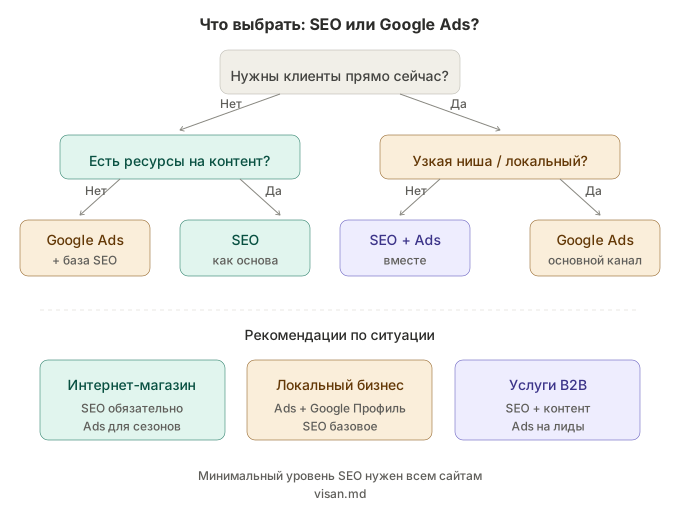
How deep to go into SEO, though, depends on your situation. Online stores and service websites in competitive niches need to work on optimization seriously and continuously. For a small local business, the basic level plus work on your Google Business Profile may be enough. There's no universal recipe — you have to look at the specific case.
Google Ads — when it works
If SEO is a marathon, Google Ads is a sprint. Launch a campaign — and today you can already get your first clicks, first calls, first leads. For many businesses this is critical: there's no time to wait six months, they need customers now.
When Ads is the best choice
The main advantage of paid advertising is speed. You fully control how much you spend, which queries you show up for, in which region, at what time. Want to — launch it; want to — stop it. Need more leads — increase the budget. Everything is transparent and measurable.
There are situations where Google Ads is the optimal choice. A narrow niche with not many search queries, where there's no point building a large-scale SEO strategy. A local business where it's enough to show up for a few key phrases in your city. A small five-to-ten-page website where there's simply no room for content for search optimization. Or a situation where the owner has neither the time nor the desire to deal with articles, a blog or descriptions — but needs customers.
In such cases, ads solve the problem. You set up a campaign, allocate an ad budget, and get a stream of inquiries. Yes, it's an ongoing expense. But if it pays off — what does it matter? The business runs, customers come, the numbers add up.
Limitations of advertising
But this is where the nuances begin.
First — ads require a decent website. I've seen it dozens of times: someone puts money into Google Ads, gets clicks, but no leads. We start digging — the site loads slowly, the forms don't work, the phone number is hidden where you can't find it, and the offer itself doesn't grab anyone. People come and go. Money spent, zero results. Without a good website, advertising is just burning your budget.
Second — the cost of Google Ads. In competitive niches the cost per click can be very high. Dentistry, legal services, windows, renovation — a click there can cost a dollar, three, or five. If the site's conversion rate is low, the economics quickly stop adding up. You pay for visits but get few customers.
Third — the ad blindness I already mentioned. People have learned to ignore ad blocks. They automatically scroll past the first lines labeled "Sponsored" and go to the organic results. Not everyone, of course. But enough people to affect the results.
And fourth — changes in the search results themselves. When there's an AI answer from Google above the ads that immediately gives the user what they were looking for, they may simply never scroll down to your ad. That's a reality you have to reckon with.
Does this mean advertising no longer works? No. It works. But not the way it used to. You can't just throw a budget at it and wait for a miracle. You need a decent website, a clear offer, competent campaign setup and ongoing work on improving performance.
And one more thought I discuss with clients more and more often. Advertising on its own is no longer a complete solution. It works well as part of a system: bring a person to the site, then follow up with retargeting, show content on social media in parallel, build a list, nurture. But that's a topic for a separate conversation — how to reach people at all today, when there's so much noise around.
SEO vs Google Ads — comparison
| Criterion | SEO | Google Ads |
|---|---|---|
| Speed of results | 3–6 months to first rankings | Traffic on launch day |
| Long-term cost | An investment. Traffic stays after the work ends | An ongoing expense. No budget = no traffic |
| User trust | Higher. Organic results feel like a recommendation | Lower. Ads are often ignored |
| Control | Limited. Depends on Google's algorithms | Full. Budget, timing, geo, audience |
| Competition | Hard in competitive niches | Expensive in competitive niches |
| Website requirements | High. Content, structure, speed | Medium. Conversion is what matters |
| Best suited for | Online stores, services, informational sites | Local businesses, narrow niches, a fast start |
Three stories from practice
Theory is good, but examples work best. Here are three cases from my practice that illustrate well how differently website promotion can be built in different markets.
A barbershop in a CIS country. A small barbershop, a few barbers, a local business. The website is simple — essentially a business card with the address, prices and a booking form.
The owners aren't interested in running a blog, writing articles about men's haircut trends or doing content marketing. And they don't need it — the business isn't that size.
What did we do? We launched Google Ads for local queries. Barbershop, men's haircut, near me — all combined with geotargeting. The campaign runs steadily, brings in new customers and pays for itself. SEO there is minimal — the page is optimized, the Google Business Profile is fully filled in, the speed is fine. That's enough.
The conclusion is simple: not every business needs complex SEO. Sometimes the basics plus well-configured ads are enough.
A mobile car wash in a European country. This story is more interesting. We started from scratch: a new site, zero visibility in search. The only way to get customers quickly was advertising. We launched Google Ads, targeted the right queries, and it took off. The ads pay off handsomely — every euro invested comes back many times over.
But in parallel we also started working on SEO. Gradually, without strain. We optimized the pages, added content, worked on local presence. After a while the site began appearing in organic results and bringing in customers as well.
And here's the interesting part. When we looked at the stats, it turned out that visitors from organic search convert better than those from ads. The share of people who become customers is higher. Why? Presumably it's a matter of trust: the person found the business themselves rather than clicking an ad.
Now they run both channels. Ads deliver a steady flow, SEO delivers "free" customers with good conversion. Together — a great combination.
A dental clinic. A completely different situation. The niche is competitive, clicks are expensive. We launched ads — they work, but the cost of acquiring a patient is high. Plus there's a specific factor: people often look for a dentist near their home or office. Local targeting is on, but even that doesn't always help — someone clicks, sees the address, realizes it's too far, and leaves. The money for the click is already spent.
Local SEO, on the other hand, really took off here. The site was optimized step by step, with work on content and structure. Now it consistently brings in 70 to 100 visitors a day from organic search. For free. Every day. These people were specifically looking for the services the clinic provides, and found it themselves. Conversion is good.
Ads run there too; they haven't been switched off. But the main flow comes from SEO, and in the long run that's significantly more cost-effective.
Three different businesses, three different approaches. The barbershop gets by with ads. The car wash needs both channels. The dental clinic relies mostly on SEO. There's no universal recipe — there's analysis of the situation and common sense.
So what should you choose — my position
Over 17 years I've tried different approaches and seen different results. And if someone asked me briefly — SEO or ads — I'd answer: it depends on the situation. But that would be too simple an answer. So let me be more specific.
If customers don't come to you on their own — through word of mouth, referrals, walk-ins — and you're counting on the internet, then you need SEO. At least at a basic level. That's non-negotiable. A sensible site structure, clear headings, meta tags, fast loading, a mobile version. That's the minimum without which there's no point even talking about promotion. Without this foundation, neither ads nor SEO will really work.
If you have a narrow specialization, a small site and no one to handle content — Google Ads is your friend. Yes, it's an ongoing expense. But if the ads pay off and bring customers, it's a perfectly good working tool. There's no need to be shy about using it. Not everyone has the resources for full-scale SEO, and that's fine.
But if you have an online store or a service website in a reasonably competitive niche, you need to work on optimization no matter what. It's not an option, it's a necessity. Because in the long run, free search traffic is an asset that works for you all the time. Ads are an expense that stops working the moment you stop paying.
The ideal combination is when both channels work. SEO as the foundation that's built gradually and delivers a steady flow. Ads as an amplifier that delivers results here and now, helps in peak season and fills the gaps. Together they complement each other.
And one more thought I want to get across. If there's a chance to break into the top organic results — go for it. Yes, it's harder than before. Yes, AI answers and overloaded results make the task harder. But those who invest in quality content and competent optimization now will gain an advantage over those who don't. Search isn't going anywhere. People keep googling. The only question is whether they'll find you or your competitors.
In lieu of a conclusion
There's no universal answer to "SEO or ads?" It all depends on your business, your niche, your resources and your goals. For some, well-configured ads are enough. Others need serious SEO. Most need a combination of both in different proportions.
The main thing is not to blindly copy other people's decisions but to look at your own situation. Analyze, test, measure results. And adjust course as you go.
In the next article I'll talk about how to reach people at all today, when ads work worse and worse and attention is scattered. How to break through the noise and get noticed and remembered. It's a big topic in its own right, and it's becoming more relevant every day.
Want to figure out what's right for your business? Request a free consultation — we'll look at your situation and choose a strategy that will work.
FAQ: SEO or Google Ads
1. Which is better for a small business — SEO or Google Ads?
There's no universal answer — it depends on your situation. If you need customers right now and have a budget, start with Google Ads. If you're ready to work for the long term and want free traffic, invest in SEO. The ideal option is a combination: ads deliver quick results, SEO builds a long-term foundation.
2. How long does it take to see results from SEO?
The first results usually appear after 3–4 months of work. Reaching the top for competitive queries takes 6–12 months. It's not a fast tool, but the traffic stays with you even after active work ends — unlike ads, which stop along with the budget.
3. Why has Google Ads become less effective than before?
For several reasons. People have learned to ignore ad blocks — this is called banner blindness. The results page is overloaded: first ads, then Google's AI answer, then "People also ask", maps, videos. Users may simply never scroll down to your ad. Plus competition has grown — clicks have become more expensive and conversion rates have dropped.
4. Can you rely on ads alone without SEO?
You can, if you have a narrow niche, a small business-card website and no resources for content. For example, a local barbershop or car wash can get by with basic SEO plus well-configured ads. But if you have an online store or a service website in a competitive niche, without SEO you overpay for every customer and depend on your ad budget.
5. What are AI Overviews and how do they affect promotion?
AI Overviews are answer blocks that Google generates with artificial intelligence and shows at the very top of the results. The user gets the information without clicking on any website. This means even the first organic position or a top ad can go unnoticed. Adapting to this is a new challenge for SEO specialists.
6. What minimum SEO should every website have?
Basic on-page optimization: a clear structure, proper H1–H3 headings, filled-in meta tags, human-readable URLs. The technical side: fast loading, a responsive mobile version, no critical errors. And a complete Google Business Profile for local businesses. This is the foundation without which neither ads nor further SEO will work properly.
Related: AI content and SEO in 2026: does Google penalize it